Facebook Ads for Dropshipping in 2026: A No-BS Beginner's Guide
Facebook Ads for Dropshipping in 2026: The Complete Beginner Playbook
Facebook and Instagram ads remain the most reliable paid traffic source for dropshipping stores in 2026, but the playbook has changed. iOS privacy updates, increased competition, and algorithm shifts mean the old "duplicate and scale" strategies no longer work the way they used to. This guide walks you through exactly how to launch, test, and scale a profitable Facebook ad campaign from scratch, with real budgets, bidding strategies, creative formats, and scaling rules.
Whether you are spending $300 or $3,000 on your first campaign, the framework below will help you avoid the mistakes that drain beginner budgets.
What You Need Before You Launch Ads
Do not run a single ad until you have these basics in place. Beginners who skip this step burn money on traffic that cannot convert.
1. A Fast, Mobile-Optimized Store
Over 70% of your Facebook ad traffic will come from mobile. If your store takes more than 3 seconds to load, you are losing customers before they even see your product. Test your store on an actual phone over cellular data, not just WiFi.
Use a lightweight Shopify theme (Dawn, Sense) and limit apps to the essentials. Every app you install adds load time.
2. A Product Page That Converts
A great ad is worthless if your product page does not convert. Before spending on ads, ensure your page has:
- A clear, benefit-driven headline
- At least 4-5 high-quality product images
- A product demonstration video (even a simple one)
- Trust badges, reviews, or social proof
- A clear call-to-action above the fold
- Shipping and return policy visible
Aim for a baseline conversion rate of at least 1.5% before scaling ads. Below that, fix the page first.
3. The Meta Pixel and Conversions API
Install the Meta Pixel on your store and set up the Conversions API (CAPI) through your Shopify store or a tool like TriplePixel. CAPI sends purchase data server-to-server, recovering data lost to iOS tracking restrictions. Without it, your pixel is underreporting 20-40% of conversions, and the algorithm cannot optimize properly.
4. A Clear Break-Even CPA
Use the Break-Even ROAS Calculator on this page to find the maximum you can spend to acquire one customer. If your product sells for $29.99 with $15 net profit, your break-even CPA is $15. If your actual CPA on Facebook exceeds that, you are losing money.
Campaign Structure for Beginners
The most effective campaign structure for testing a new dropshipping product in 2026 is simple. Complexity kills beginners.
The Testing Structure
One campaign, three to four ad sets, two to three creatives per ad set.
| Element | Detail |
|---|---|
| Campaign Objective | Sales (Conversions) |
| Buying Type | Auction |
| Campaign Budget Optimization (CBO) | Off for testing, On for scaling |
| Number of Ad Sets | 3-4 |
| Creatives Per Ad Set | 2-3 |
| Budget Per Ad Set | $20/day |
| Total Daily Budget | $60-$80/day |
Ad Set Configuration
- Ad Set 1: Broad (no interests, no lookalikes). Target your entire target country (US, UK, AU, CA). Age 18-65+. All placements. Let the algorithm find your buyers based on creative.
- Ad Set 2: Interest-based (one interest). Pick one broad interest related to your product. For a posture corrector, "back pain" or "ergonomics."
- Ad Set 3: Interest-based (different interest). A second single interest. For the posture corrector, "office workers" or "fitness."
- Ad Set 4 (optional): Lookalike audience. Once you have 100+ purchases, create a 1% lookalike of purchasers.
Why Broad Targeting Works in 2026
Meta's algorithm has become extremely good at finding buyers based on your creative and pixel data. Broad targeting (no interests) often outperforms interest-based targeting because the algorithm has more data to work with. Many top media buyers now run 70-80% of their budget on broad.
Testing Strategy: Days 1-3
Your goal in the testing phase is not profitability. It is data. You want to learn which creatives and audiences have potential so you can double down on winners.
Day 1: Launch and Let Run
Launch your campaign and do not touch it for 24 hours. The algorithm needs time to exit the learning phase. Checking results every two hours and panicking is the number one beginner mistake.
Day 2: Early Signal Check
After each ad set has spent approximately $20, check the following signals:
| Metric | Good | Great | Kill |
|---|---|---|---|
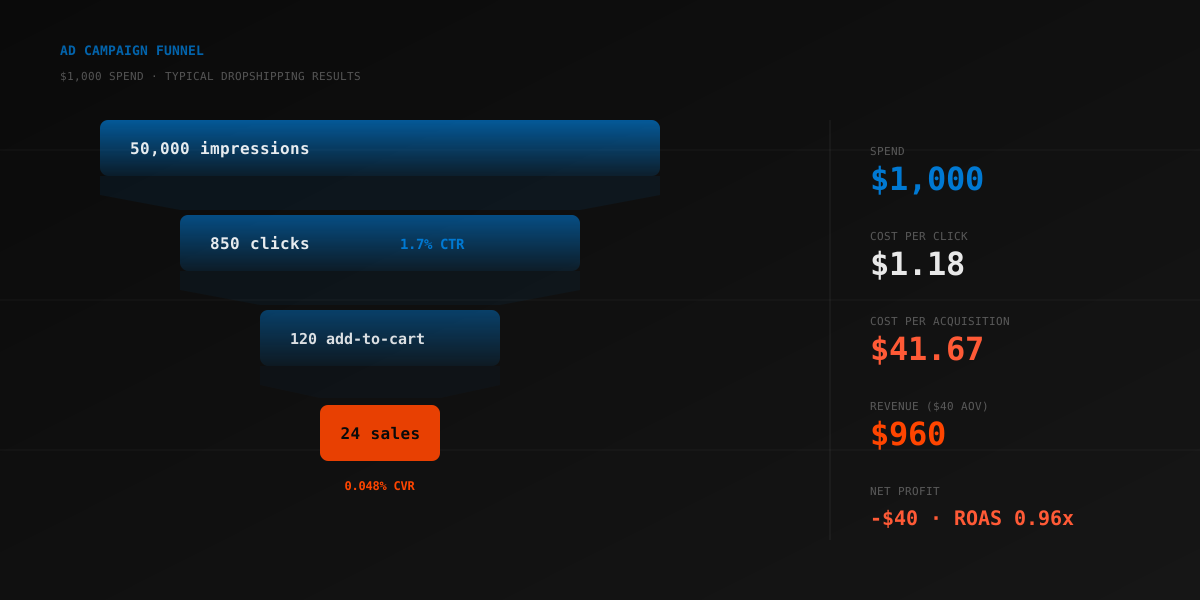
| CTR (Link) | 1.5%+ | 3%+ | Below 0.8% after $20 |
| CPC | Under $1.50 | Under $1.00 | Over $3.00 |
| CPA | Near break-even | Under 50% of break-even | Over 2x break-even |
| CPM | Under $25 | Under $15 | Over $40 (market dependent) |
Use the CTR Calculator and CPA Calculator on this page to track these metrics accurately.
Day 3: Optimization and Cuts
- Kill any creative with CTR below 0.8% after $20 spend. It is not going to improve enough.
- Kill any ad set with CPA above 2x your break-even after $40-50 spend.
- Do not kill an ad set just because it has no purchases yet. If CTR is above 1.5% and CPC is reasonable, the algorithm may still be learning. Give it another day.
- Note which creatives are performing. These are your scaling candidates.
Common Day 1-3 Mistakes
- Turning ads off too early (before the learning phase completes)
- Judging results before $20 is spent per ad set
- Scaling budget before identifying a consistent winner
- Running only one creative (you need at least 4-6 to find a winner)
Creative Strategy: What Actually Works in 2026
Creative is the single biggest driver of Facebook ad performance in 2026. Targeting matters less than it used to. If your creative is good, broad targeting will find buyers. If your creative is bad, no targeting will save you.
Winning Creative Formats
UGC-Style Videos (Best Performer). User-generated content style videos showing a real person using the product. Shoot vertically on a phone. 15-30 seconds. Feels authentic, not like an ad. These consistently outperform polished studio content.
Problem-Solution Demo. Open with the problem (back pain, messy car, pet hair everywhere), show the product solving it in 5 seconds, end with offer. This is the most reliable structure for dropshipping.
Before/After Montage. Show the transformation. Car before headlight restoration, then after. Face before LED therapy, then after. Visual proof sells.
Founder/Story Angle. "I started this store because..." Works for brand building but less effective for cold conversion of novelty products.
Static Images with Strong Hooks. A single striking image with bold text overlay. Lower cost to produce but generally lower CTR than video. Use as a complement to video, not a replacement.
The First 3 Seconds Are Everything
Facebook charges you per impression, but the first 3 seconds of your video determine whether someone watches or scrolls. Your hook must:
- Show the product immediately (not a logo animation)
- Present the problem or benefit in the first frame
- Use movement to stop the scroll (someone opening a package, applying a product, showing a result)
Creative Volume
Plan to test 6-10 creatives per product. Most will fail. One or two will be winners. This is normal and expected. Budget for creative production as a core cost of your ad strategy.
Use the Ad Copy and Hook Generator on this page to generate initial creative concepts and hooks.
Scaling Strategies: How to Grow Without Killing Performance
Once you have a winning ad set (consistent purchases at or below break-even CPA for 3+ days), it is time to scale. There are three main approaches, and most experienced media buyers use a combination.
Vertical Scaling (Increasing Budget)
The simplest method. Take your winning ad set and increase the budget.
The 20% Rule: Increase budget by no more than 20% every 48 hours. Going from $20/day to $100/day overnight triggers the learning phase again and often destroys performance.
Example: $20/day (Day 1-3) -> $24/day (Day 4-5) -> $29/day (Day 6-7) -> $35/day (Day 8-9)
Monitor CPA closely. If CPA spikes above break-even after a budget increase, revert to the previous level and wait 48 hours before trying again.
Horizontal Scaling (New Audiences)
Duplicate your winning ad set and target new audiences. If your winner is on broad US, duplicate it for UK, Australia, Canada. Duplicate it with a new interest. Duplicate it with a lookalike audience.
Horizontal scaling carries lower risk than vertical scaling because you are not disrupting a working ad set. You are adding new ones.
Creative Scaling (New Ads on Winning Audiences)
Your winning audience will eventually experience ad fatigue. CTR drops, CPM rises, CPA climbs. Combat this by continuously feeding new creatives into your winning ad sets.
A good rhythm: introduce 1-2 new creatives per week per winning ad set. Kill fatigued creatives when frequency exceeds 3.0 and CTR drops 30% from peak.
Scaling Budget Milestones
| Revenue Level | Daily Ad Spend | Focus |
|---|---|---|
| $0-$1,000/month | $50-$100/day | Testing, finding winners |
| $1,000-$5,000/month | $100-$300/day | Vertical and horizontal scaling |
| $5,000-$20,000/month | $300-$800/day | Creative scaling, new geo |
| $20,000+/month | $800+/day | Full funnel, retargeting, brand |
Bidding and Budget Strategies
Auction Basics
Facebook uses a Vickrey-Clarke-Groves auction. You are competing against other advertisers for the same audience. Your cost per impression depends on your bid, estimated action rate, and ad quality.
Budget Options
- Ad Set Budget (ABO): You set a daily budget per ad set. Best for testing because it forces even spend across ad sets. Recommended for beginners.
- Campaign Budget (CBO/Advantage+): Facebook distributes budget across ad sets automatically. Best for scaling once you know which ad sets work. Can starve new ad sets of budget during testing.
Bid Strategy
For beginners, use Highest Volume (default) bid strategy. Let Facebook optimize for the lowest CPA. Advanced options like Cost Cap or Bid Cap are useful once you have stable data (50+ conversions per week) but can throttle delivery for beginners.
Advantage+ Shopping Campaigns
Meta's Advantage+ Shopping Campaigns (ASC) use machine learning to automate targeting, placement, and creative selection. Many dropshippers report strong results with ASC once they have 50+ conversions. Test it as a scaling vehicle, not a testing vehicle.
Tracking and Measurement
Metrics to Monitor Daily
- Spend: Total daily spend vs. budget
- CPA (Cost Per Acquisition): Your primary profitability metric
- ROAS (Return on Ad Spend): Revenue divided by spend. Use the ROAS Calculator on this page.
- CTR (Link Click-Through Rate): Creative health indicator
- CPC (Cost Per Click): Audience and bidding competitiveness
- CPM (Cost Per 1,000 Impressions): Audience saturation signal
- Frequency: How often the same person sees your ad (over 3.0 = fatigue)
The ROAS vs Profitability Trap
High ROAS does not always mean high profit. If your product has thin margins, a 3x ROAS might still lose money after product cost and shipping. Always calculate back to net profit, not just ROAS.
Use this formula:
Break-Even ROAS = Sale Price / (Sale Price - Product Cost - Shipping - Fees)
If your break-even ROAS is 2.0x and you are running at 2.5x ROAS, you are profitable but barely. Aim for at least 1.5x your break-even ROAS to have a safety margin.
Common Facebook Ads Mistakes Beginners Make
- Targeting too narrow. Stacking 5 interests and narrowing by age, gender, and placement. The algorithm needs room. Go broad.
- Killing ads too early. Facebook ads need 50 conversions to exit the learning phase. Killing an ad set after $15 spend means you never gave it a chance.
- Scaling too fast. Doubling budget overnight resets the learning phase and spikes CPA. Scale by 20% every 2 days.
- Only running one creative. You need a minimum of 4-6 creatives to find a winner.
- Ignoring creative fatigue. If your CTR drops and frequency rises above 3.0, your audience is tired of your ad. Refresh creative.
- Not installing CAPI. Without the Conversions API, you are losing 20-40% of conversion data on iOS users.
- Optimizing for the wrong event. Beginners should optimize for Purchase, not Add to Cart or View Content. The algorithm needs the purchase signal.
A Realistic Budget Timeline
Here is what a realistic first month of Facebook ads looks like for a beginner with a $1,500 total budget.
| Week | Spend | Focus | Expected Outcome |
|---|---|---|---|
| Week 1 | $300-$400 | Creative testing, find a winner | Identify 1-2 winning creatives/audiences |
| Week 2 | $350-$400 | Kill losers, scale winners 20% | First consistent sales, CPA stabilizing |
| Week 3 | $350-$400 | Horizontal scaling, new creatives | CPA improving, daily sales consistent |
| Week 4 | $300-$400 | Optimize, prepare for scale | Profitable or near-profitable campaign |
If after $400-$500 you have no ad set with CTR above 1% or any purchases, the problem is likely your product or creative, not your Facebook ads strategy. Go back to the product research phase.
The Bottom Line
Facebook ads in 2026 reward simplicity, creative quality, and patience. Start with a clean store, test 6-10 creatives across 3-4 broad ad sets, let the algorithm work for 48-72 hours before making decisions, and scale winners gradually. The tools on this page, the ROAS Calculator, Break-Even ROAS Calculator, CTR Calculator, and CPA Calculator, exist to help you make data-driven decisions instead of guessing.
Your first campaign may not be profitable. That is normal. The goal of your first $300-$500 is not profit. It is learning what works so your next campaign is. Track your metrics, iterate on creative, and the numbers will improve.