Dropshipping Profit Margins in 2026: The Real Numbers Nobody Talks About
What Are Realistic Dropshipping Profit Margins in 2026?
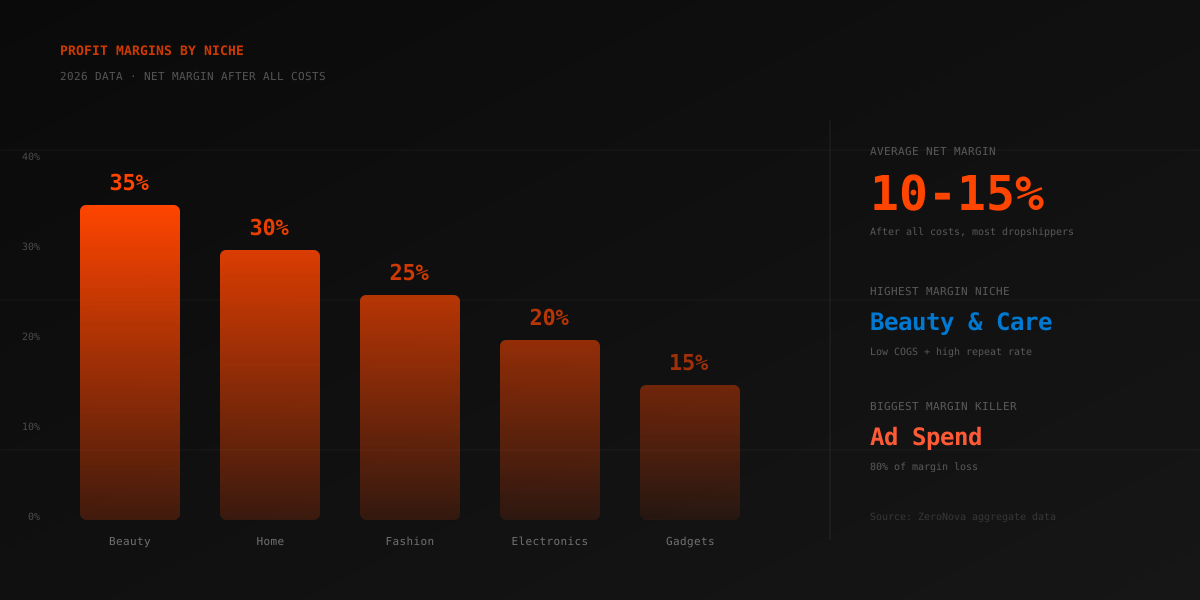
If you have read any dropshipping guru thread lately, you would think everyone is pocketing 40-50% profit margins on every order. The reality is far less glamorous. After accounting for product cost, shipping, ad spend, payment processing, returns, platform fees, and the dozen other line items that quietly eat into revenue, the average profitable dropshipper in 2026 lands between 10% and 20% net margin. Beginners often operate at a loss for the first few months before they dial in their unit economics.
This guide breaks down exactly what profit margins look like by niche, gives you the formulas to calculate your own, and walks through real case studies so you can benchmark your store against reality instead of YouTube screenshots.
The Core Profit Margin Formula
Before diving into niche benchmarks, you need to understand the formula that determines whether you actually make money on each sale.
Gross Margin vs Net Margin
Gross Margin is what you keep after the cost of the product and shipping:
Gross Margin = (Sale Price - Product Cost - Shipping Cost) / Sale Price x 100
Net Margin is what you keep after EVERY cost, including ads, fees, returns, and overhead:
Net Margin = (Sale Price - ALL Costs) / Sale Price x 100
The gap between gross margin and net margin is where most dropshippers get blindsided. A product might show 70% gross margin on paper but only deliver 8% net margin once ad spend is factored in.
The Full Cost Stack
Here is every cost that should go into your net margin calculation:
| Cost Category | Typical Range | Example ($30 Sale) |
|---|---|---|
| Product Cost (supplier) | 15-35% of sale price | $6.00 |
| Shipping to Customer | 8-20% | $4.00 |
| Ad Cost Per Sale (CPA) | 20-50% | $10.00 |
| Payment Processing | 2.9% + $0.30 | $1.17 |
| Platform Fee | 2-15% (depends on platform) | $0.60 (Shopify) |
| Transaction/Platform Fees | varies | $0.30 |
| Returns & Refunds | 5-10% of revenue | $2.10 |
| Customer Service | $0.50-$2.00 per order | $1.00 |
Add those up and your total cost on a $30 order could easily reach $25.17, leaving you with $4.83 net profit (16.1% net margin).
Use the Profit Margin Calculator on this page to plug in your own numbers. It is the fastest way to see your true profit per sale.
Profit Margins by Niche: 2026 Benchmarks
Not all niches are created equal. Below are the realistic margin ranges we have observed across active stores in 2026, along with the factors driving each.
Fashion and Accessories: 12-22% Net Margin
Fashion has low product costs (typically $2-8 from Chinese suppliers) but suffers from brutal return rates. Clothing return rates run 25-40% in dropshipping because sizing is inconsistent and customers cannot try items on. Every return costs you a shipping label, a restocking effort, and often a refund you cannot fully recover.
Where the money goes: Returns and refunds eat 8-12% of gross revenue here, compared to 3-5% in most other niches. Ads are also expensive in fashion because the audience is broad and competitive.
How to protect margins: Focus on accessories (sunglasses, watches, bags) rather than fitted clothing. Accessories have return rates under 10% and perceived value is easier to control through branding.
Electronics and Gadgets: 8-18% Net Margin
Electronics carry higher ticket prices ($25-60 typical), which helps absorb fixed fees like the $0.30 transaction charge. However, competition is fierce, product lifecycles are short (a hot gadget today is dead in 6 weeks), and quality issues lead to chargebacks.
Where the money goes: Chargeback rates in electronics run 1.5-3%, roughly double the e-commerce average. Warranty claims and defective product replacements add another 2-4% to costs.
How to protect margins: Source from suppliers with quality control (CJ Dropshipping, Spocket US warehouses) rather than the cheapest AliExpress listing. Pay $1-2 more per unit to avoid $15 chargebacks.
Home and Living: 18-28% Net Margin
Home products (decor, organizers, kitchen gadgets, lighting) offer some of the best overall margins in dropshipping. Competition is lower than fashion, perceived value is high, and the products photograph well for ads.
Where the money goes: Shipping can be expensive for bulky items. A $12 decor piece that weighs 1.5kg might cost $6-8 to ship, eroding margin fast.
How to protect margins: Focus on lightweight home accessories under 500g. A $4 LED night light that costs $1.50 to ship is more profitable than a $20 lamp that costs $9 to ship.
Beauty and Personal Care: 22-35% Net Margin
Beauty has the highest margins in dropshipping thanks to extremely low product costs ($1-4 for serums, tools, accessories) and high perceived value. Repeat purchase rates are also strong, boosting lifetime value.
Where the money goes: Regulatory compliance and ingredient claims can create liability. A single FDA complaint or allergic reaction claim can cost thousands.
How to protect margins: Stick to tools and accessories (LED face masks, massage rollers, ice globes) rather than consumable cosmetics that touch skin. Same high margins, fraction of the liability.
Pet Products: 15-25% Net Margin
Pet owners are emotional buyers who spend freely, making this a consistently profitable niche. Product costs are moderate ($3-10) and perceived value is high among devoted pet parents.
Where the money goes: Ad costs in the pet niche have risen 30-40% since 2023 as more dropshippers have entered the space. CPA for pet products now averages $8-15.
How to protect margins: Niche down. "Dog" is too broad. "Dog anxiety" or "senior dog joint support" has lower ad costs and higher conversion rates.
Fitness and Wellness: 10-20% Net Margin
Fitness gear has strong demand but heavy competition from established brands and Amazon. The niche works best for novel, problem-solving products (posture correctors, resistance bands with unique designs) rather than commodity items.
Where the money goes: Returns are moderate (10-15%), but ad costs are high because fitness is a saturated ad category.
Real Case Study: A $30 Product Broken Down
Let us walk through a complete unit economics breakdown for a fictional but realistic product: a posture corrector sold for $29.99.
| Line Item | Amount |
|---|---|
| Sale Price | $29.99 |
| Product Cost (CJ Dropshipping) | -$5.50 |
| Shipping (ePacket, US warehouse) | -$3.95 |
| Shopify Payment Fee (2.9% + $0.30) | -$1.17 |
| Ad Cost Per Sale (CPA at $12) | -$12.00 |
| Returns Reserve (7% of revenue) | -$2.10 |
| Apps & Software (amortized) | -$0.40 |
| Customer Service (amortized) | -$0.50 |
| Net Profit Per Sale | $4.37 |
| Net Margin | 14.6% |
That 14.6% is a healthy, realistic margin for a winning product in 2026. If your CPA rises to $15, your net margin drops to 9.6%. At $18 CPA, you are at 4.6% and barely breaking even after overhead.
This is why controlling ad cost per sale is the single biggest lever on your profit margin. A $3 reduction in CPA (from $12 to $9) increases your net profit by 69% on this same product.
7 Ways to Improve Your Dropshipping Margins
1. Negotiate Supplier Pricing
Once you are doing 50+ orders per month of a product, message your supplier and negotiate. Most Chinese suppliers will drop prices 10-20% for consistent volume. On a $5 product, a $1 reduction is a 20% cost cut that flows directly to your bottom line.
2. Increase Average Order Value
Bundles, quantity discounts, and post-purchase upsells can raise your AOV from $30 to $45 without increasing ad spend. Since fixed costs (payment processing, ad CPA on the first item) do not scale linearly, every incremental dollar of AOV carries higher margin.
A $30 order at 15% margin = $4.50 profit. A $45 order (with a $10 bundle add-on at 50% margin) = $9.50 profit. Same ad cost. Double the profit.
3. Reduce Return Rates
Returns are a margin killer. Invest in accurate product photos, sizing guides, and honest descriptions. Adding a 30-second video showing the product in real use can cut return rates by 30-40%.
4. Optimize Ad Creative
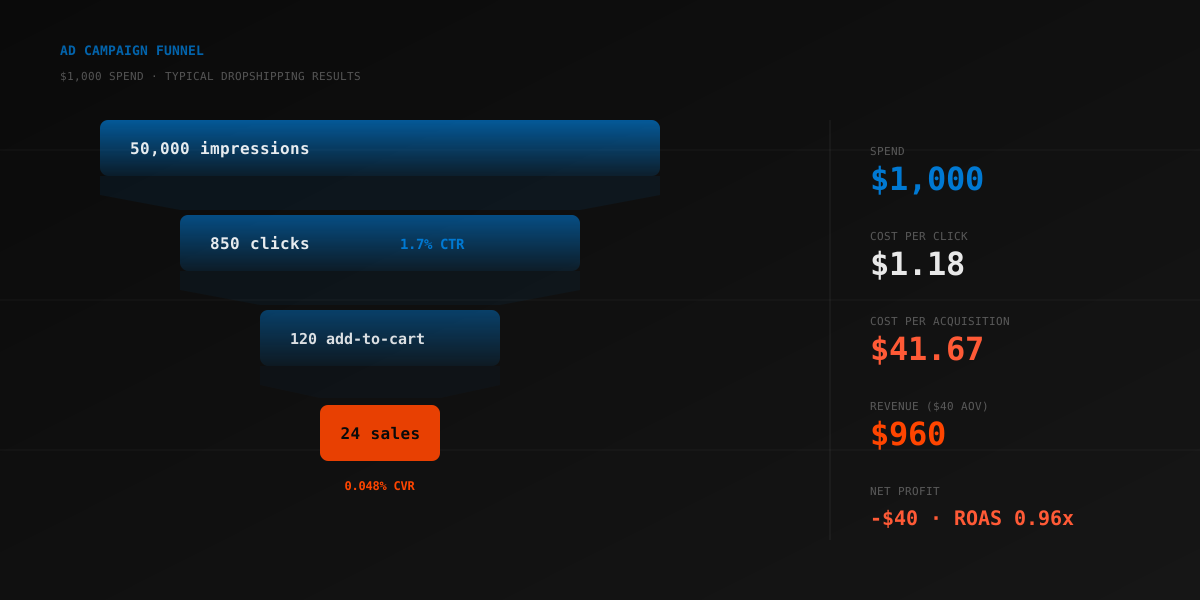
Since ad spend is 30-50% of total costs for most dropshippers, improving your click-through rate and conversion rate has the biggest impact. A creative that lifts CTR from 1.2% to 2.5% can cut your CPA by 40%, which directly adds dollars to your margin.
5. Move to Private Label
Once a product is proven, source it privately through Alibaba with your own branding. This cuts product cost 15-30%, eliminates competition selling the identical listing, and builds a sellable asset.
6. Switch to Faster Shipping
Counterintuitively, faster shipping can IMPROVE margins by reducing "where is my order" chargebacks and complaints. If upgrading from 15-day to 7-day shipping costs $1.50 more but saves you $3 in chargebacks and refunds, your margin improves.
7. Cut Platform Fees
If you are selling on Amazon (15% fee) or eBay (13% fee), migrating winners to your own Shopify store (2-3% effective fee) can add 10+ percentage points to your margin. You trade traffic for margin, which makes sense once you have your own ad engine running.
Common Margin Mistakes to Avoid
- Forgetting to reserve for returns. If your return rate is 7% and you do not budget for it, your reported margin is 7% higher than reality. You will feel the cash crunch at month-end.
- Using gross margin to make decisions. A product with 75% gross margin but $20 CPA might be less profitable than a product with 50% gross margin and $8 CPA. Always calculate NET.
- Ignoring lifetime value. A product with 5% net margin on the first sale but a 40% repeat purchase rate may be far more profitable long-term than a one-time purchase at 20% margin.
- Underpricing to compete. Dropping your price from $29.99 to $24.99 to match a competitor does not just cost you $5 in revenue. It can wipe out 40% of your net margin because your fixed costs stay the same.
The Bottom Line on Dropshipping Margins in 2026
Realistic dropshipping profit margins in 2026 are 10-20% net for most stores, with outliers in beauty and home decor reaching 25-35%. The stores that hit the top of these ranges do so by obsessively tracking unit economics, negotiating supplier costs, optimizing ad creative, and continuously increasing average order value.
Use the Profit Margin Calculator and Break-Even ROAS Calculator on this page to model your real numbers before you spend a dollar on ads. Margins are not something you hope for. They are something you engineer.